
Top Signs You Need Air Duct Cleaning Service – Don’t Ignore These
Most “signs you need duct cleaning” lists are useless because they describe normal house conditions. Dust on a supply register is ordinary. So is a little grit near a vent. The signals that actually matter look different: dust that returns to a return grille within days, one room that stays cold while the rest of the house is fine, a smell that only shows up when the heat kicks on. Those are diagnostic signals, not cosmetic ones. In this post, we’ll walk through how to read each one. And if you’d rather have a trained eye look, call (833) 772-9858 for a free estimate.
Is dust on your vents actually a sign you need duct cleaning?
Sometimes. Not always. Dust on supply registers is normal house dust settling on a cool surface, and it means very little. Dust on return grilles is a different signal, because returns pull air back to the system. When a return grille darkens again within days of a wipe-down, the system is telling you something. Three things cause it.
- An undersized filter. A filter with too little surface area chokes quickly and starts bypassing air around its edges, pulling dust straight into the return.
- A filter seated wrong. A filter that sits crooked or isn’t fully seated in its slot lets unfiltered air through, and the grille downstream pays for it.
- A breach in the duct system. A gap at a joint, a disconnected run, or a crack near the return lets attic or crawlspace air into the ductwork. That air carries whatever’s in the attic.
Here’s the visual test we suggest to homeowners in South Hill: wipe one return grille and one supply register clean, note the date, and look again in a week. If the supply is still fairly clean but the return is dirty, the problem is upstream. If both return dirty fast, it’s likely a filter issue first and duct condition second. Those are two different fixes, and knowing which one you’re looking at saves you from paying for the wrong service.
Do uneven room temperatures really mean dirty ducts?
Rarely by themselves. Uneven temperatures are one of the most misread symptoms in HVAC, because people assume the fix is cleaning when the actual cause is usually airflow design. Cleaning helps when buildup is physically restricting a run. It does little for a duct that was never sized correctly for the room. In our experience around South Hill, this is the honest split:
- One room consistently 4-6 degrees off, both heating and cooling: usually a balance issue – closed damper, long duct run, or a register sized too small for the room.
- A room that got worse over the last year or two: more likely buildup inside the run, a crushed section of flex duct, or a leak that’s bleeding conditioned air into the attic.
- The room furthest from the unit running cold in cooling season: often an under-insulated run losing its cool before it arrives.
The point is that a temperature complaint points you toward inspection, not straight to cleaning. A proper inspection looks inside the run and at the return pressure. If the ducts are lined with debris, air duct cleaning will absolutely help that room. If the duct is crushed or leaking, cleaning alone won’t fix the comfort problem – sealing or repairing the run will. That’s why we treat cleaning and repair as one visit when the problem calls for it, rather than handing you a checklist and a second appointment.
What does a musty smell tell you about your ductwork?
A musty smell is the single most useful signal on this list, because the source usually can be narrowed down by when the smell appears. Three different problems produce a similar musty odor, and each needs a different fix. Treating them all as “dirty ducts” is how people end up cleaning when the real answer is moisture control.
- Musty smell only when the system starts up, then fades: the evaporator coil is usually the source. A damp coil with a light biological film pushes that smell into the airstream each time the fan runs.
- Persistent smell, strongest near a specific register: often mold or mildew on the interior duct liner, especially where a run sits in a humid crawlspace or where condensation forms on the outside of cold duct metal.
- Smell in the whole house plus a damp feeling: moisture has found its way into the plenum or return boot. This is not a cleaning problem first. It’s a water intrusion problem, and the moisture source has to be closed before any cleaning will hold.
An air quality and sanitizing step makes sense once the source is handled. Using the Honeywell and Aprilaire product lines, we can address the biological film on the coil and the duct surfaces. But sanitizing over an active leak is like painting over wet wood. Find the moisture, close it, then treat the surfaces.
Why do allergy symptoms spike in one room but not others?
Because a single duct run is the culprit, not the whole house. If your allergies or a family member’s asthma flare up mainly in one room, that room’s supply run is the place to look. A single run can carry more contaminants for several reasons: it serves a room near an outside return, it passes through a crawlspace or garage, or it’s a run that was never cleaned after a renovation. We’ve seen this pattern in South Hill homes enough to treat single-room symptoms as a specific inspection target rather than a reason to clean everything blindly.
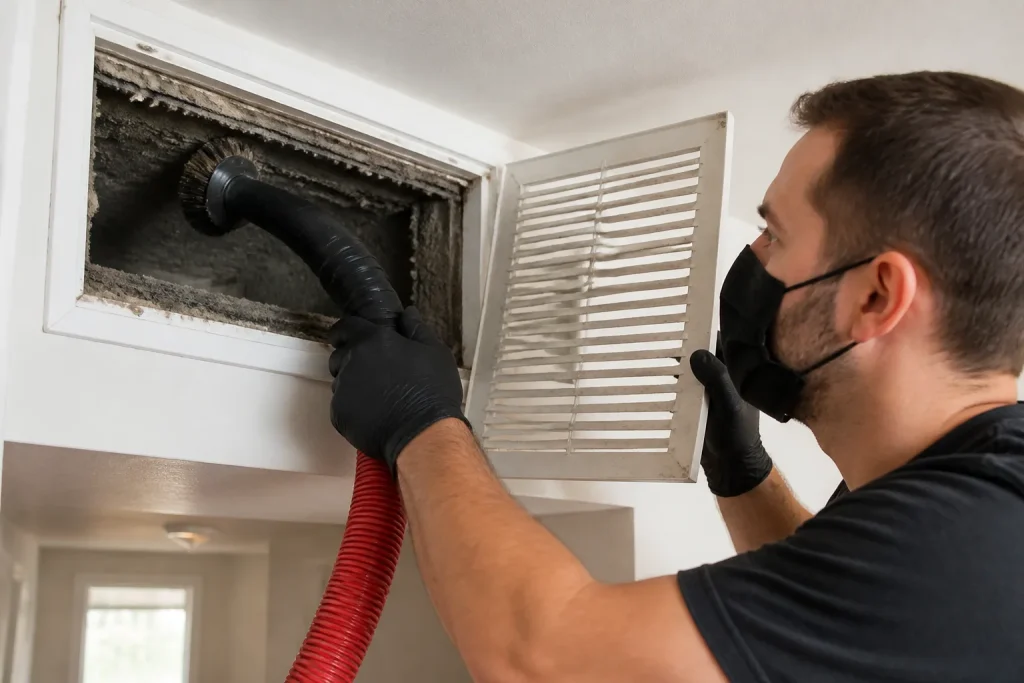
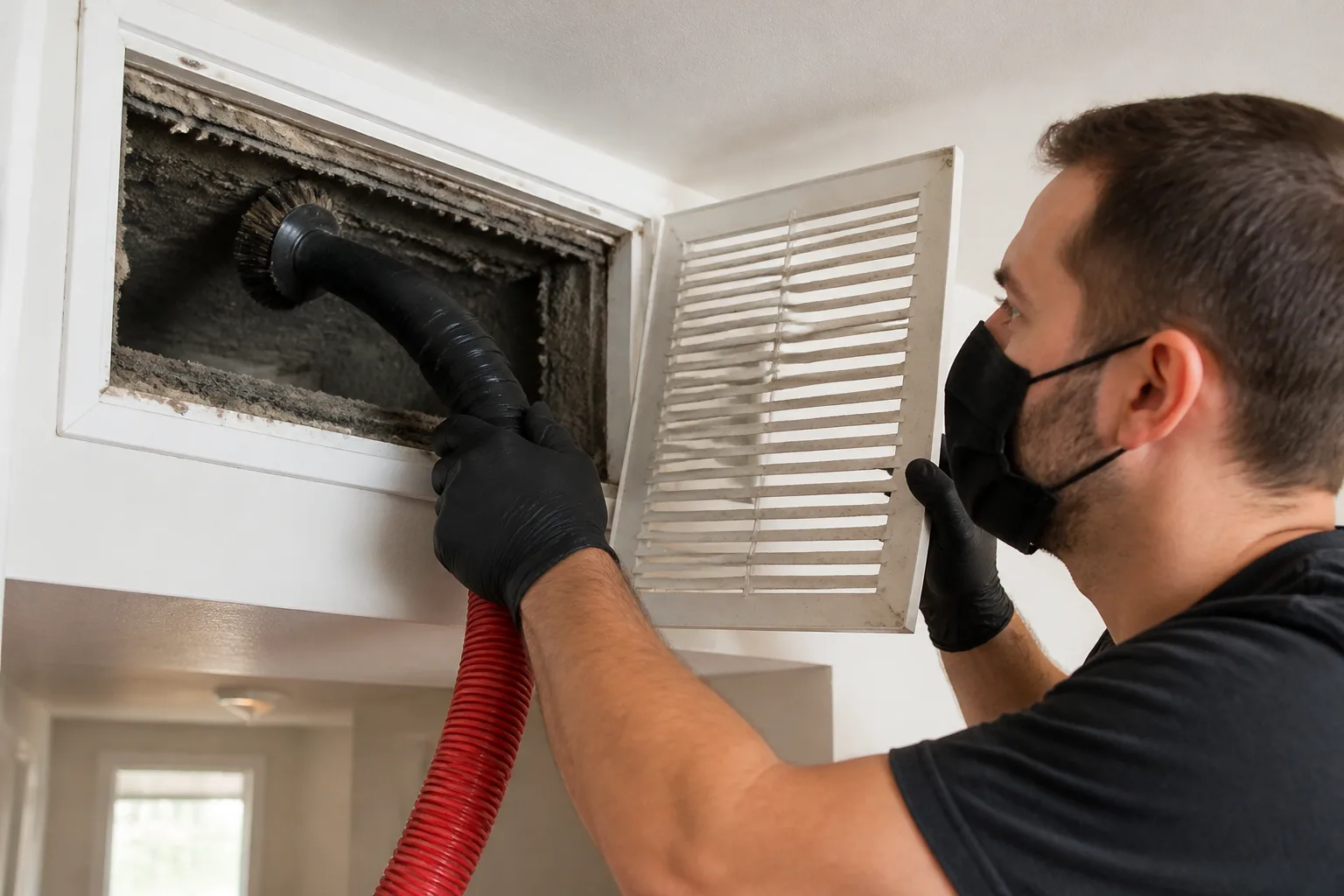
When we inspect a suspect run, we look for visible debris on the duct walls, a disconnected joint, a torn flex section, or a return near a source of outdoor dust. During cleaning we run Abatement Technologies negative-air equipment, which contains dislodged material at the work area instead of recirculating it through the house. That matters when you or someone in the home has a respiratory sensitivity – the very people most likely to be reading this section. Dryer vents deserve a mention too, since they share the same concern: dryer vent cleaning is one of the most overlooked routine jobs in a home, and lint buildup in that vent is a well-known fire risk. If a room in your South Hill home always seems to trigger symptoms, that run is worth a look.
What evidence of rodents in ducts should you watch for?
Rodent evidence has a hierarchy. Each level tells you something different about how much work the system will need. If you’re seeing it, take it seriously, because a rodent doesn’t just leave droppings behind – it contaminates duct surfaces and often chews through flex duct.
- Droppings visible at registers or in a return grille: the animal is using the duct system as a path. Cleaning and sanitizing will be part of the fix, but the entry point has to be found first or they come right back.
- Scratching or scurrying sounds in walls or ceilings: activity is inside the ductwork or between it and the structure. This may mean a disconnected joint or torn flex – an obvious invitation a rodent will take.
- Grease smears along duct interiors: rodents leave these where they travel, and they’re a strong sign of a well-worn route. By the time you see this, cleaning is not optional. It’s overdue.
What each stage requires changes. Stage one may be cleaning plus sealing the entry. Stage two almost always includes duct repair and sealing, because the tear that let them in has to be closed. Stage three means full cleaning, sanitizing, and repair in one visit. We carry repair and sealing into the same appointment for exactly this reason.
When should you call a pro instead of handling it yourself?
Call a pro when a symptom needs a look inside the duct instead of at it. You can check a filter yourself – and you should, once a month, because a filter changed on schedule prevents more dust problems than any cleaning does. Beyond that, the diagnostics require access and equipment a homeowner doesn’t have. Failing joints, moisture in the plenum, and rodent routes in ductwork are all things you can only confirm with a proper look. And when an HVAC cleaning is on the table, the buildup on the coil and blower is the same story: what you can see from a register tells you only part of it – HVAC cleaning is where that picture gets clear. Our technicians have up to 14 years of experience, and the estimate is free.
One thing we’d ask you to check before any cleaning: the source of the smell or moisture. Cleaning is the wrong first step when the real problem is a leak. Fix the leak, then clean.
Related services in South Hill
If these signals match what you’re seeing, the fix usually lives in one of five places: cleaning, HVAC cleaning, duct repair and sealing, air quality and sanitizing, or dryer vent cleaning. Most of the work we do in South Hill starts with a free inspection that tells you which of those you actually need.
What happens when you call
- 1
A real person answersNo phone trees – you reach a local pro.
- 2
You get an upfront price rangeHonest numbers before anyone is dispatched.
- 3
A background-checked tech heads outLicensed & insured, dispatched right away.
- 4
You approve before work beginsNothing starts until you say go.
The Bottom Line
Dust on a supply register is normal. A return grille that’s dirty within days is a system signal. Uneven room temperatures point to airflow, which is a repair issue more often than a cleaning issue. A musty smell is your best diagnostic clue, because it almost always comes from one of three sources, each needing its own fix. Single-room allergy spikes usually trace to one duct run. Rodent evidence moves through stages, and each stage calls for a different response. Read the signals in front of you before you buy a cleaning. If you’re in South Hill and want a trained set of eyes on your system, South Hill Air Duct Cleaning Pros offers free estimates. Call (833) 772-9858. We answer 24/7. Fast dispatch from 7am to 7pm, Sunday through Friday.
Frequently Asked Questions
Look for return grilles that darken within days of a wipe-down, a musty smell that starts when the system kicks on, symptoms that spike in one room, or visible rodent evidence. Any of those means a professional inspection is worth it. Ordinary dust on supply registers and a little dust in the air do not, by themselves, justify cleaning.
Sometimes, but it’s rarely the main cause. Buildup can restrict a run, but a room that’s always been off is usually an airflow design or balance issue. A room that got worse recently is the one worth inspecting for buildup, crushed flex, or a leak.
There’s no universal schedule. A home with pets, recent renovation, a rodent problem, or an allergy sufferer usually needs it more often than a low-occupancy home with a well-maintained filter. Change your filter monthly and inspect every year or two, and let the condition of the system tell you when cleaning is due, not the calendar.
Not always. A smell only at startup usually points to the coil. A smell at one register often means liner mold. A smell across the house with damp air usually means water intrusion in the plenum. Only the first two are cleaning-first problems. Call for an inspection so you don’t pay for cleaning when the real fix is moisture control.
Written by the team at South Hill Air Duct Cleaning Pros.
Need Air Duct Cleaning Help?
Call South Hill Air Duct Cleaning Pros - the local pro we connect you with is licensed and insured, with free written estimates in South Hill.
(833) 772-9858